Webinars

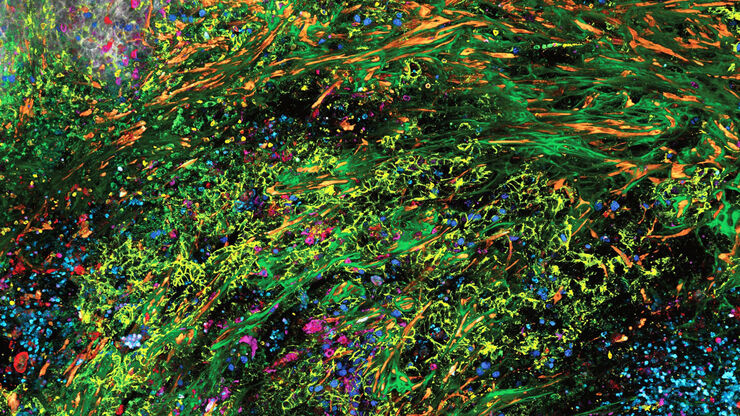
3D high-plex imaging in cancer immunology. Overview of a pancreatic tumor section in mouse model, labeled with 15 markers and imaged in one go using STELLARIS with SpectraPlex. (https://www.nature.com/articles/d42473-024-00260-7)

如何优化多标成像技术推动3D空间组学发展

本次网络研讨会上,徕卡显微系统的Julia Roberti博士与Luis Alvarez博士将介绍STELLARIS共聚焦平台的全新功能SpectraPlex,该技术可实现超多标三维空间成像。该技术旨在通过实现超多标成像且无需频繁人工干预,从而简化和增强空间生物学应用。
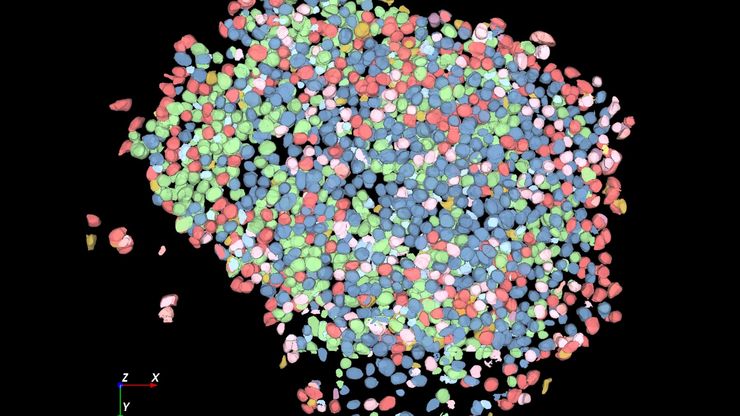
Large volume computational clearing processed Thunder image of human pancreatic islet organoid. Cells segmented using Segment By Example tool, automatically phenotyped, and color-coded based on phenotypes in Aivia. Image courtesy of the Matthias von Herrath Lab, La Jolla Institute of Immunology, La Jolla, CA.

利用人工智能图像分析工具更快、更轻松地获得洞察力

了解 Aivia 如何通过快速设置、准确的人工智能检测和简便的批量处理功能,帮助科学家简化图像分析。
Image: Human stem cell-derived mid brain organoids. Courtesy of Dr Tanya Singh, University of Oxford.

揭开类器官模型在生物医学研究中的秘密

准备深入了解类器官和3D培养物的世界,它们是促进我们了解人类健康的重要工具。浏览这些复杂的结构并获取清晰的图像进行分析是一项挑战。在本次活动中,来自牛津大学和伦敦大学学院的研究人员将与我们一起展示Thunder Imager Cell转盘共聚焦系统 如何提供更有说服力的高质量数据,以便深入了解各种模型。
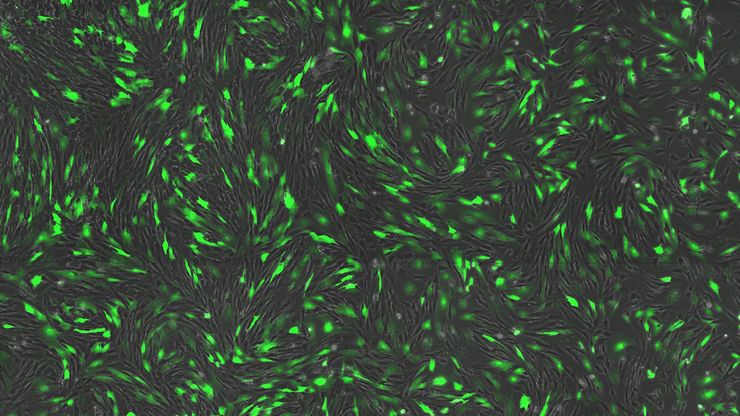
Transfection using the Uncommon Bio reprogramming system. Image acquired using the THUNDER Imager 3D Cell Culture with THUNDER Large Volume Computational Clearing (LVCC) applied. Image courtesy of Samuel East, Uncommon Bio.

利用新型可扩展的干细胞培养设计未来

具有远见卓识的生物技术初创企业 Uncommon Bio 正在应对世界上最大的健康挑战之一:食品可持续性。在这次网络研讨会上,干细胞科学家塞缪尔-伊斯特(Samuel East)将展示他们如何使细胞农业的干细胞培养基既安全又经济可行。了解他们如何将培养基成本降低 1000 倍,并开发出不含动物成分、食品安全的 iPSC 培养基。
Complete camera overview of EM grid recorded with 3 channels. Inserts displaying the positions, where superresolved 3D confocal images were recorded. 3D renderings of these positions are shown in the zoomed inserts. Fluorescence channels (nuclei by Hoechst, blue; mitochondria by MitoTracker Green, green; lipid Droplets by Bodipy and Crimson Beads, red). Width of a grid square is 90 ?m, width of a grid bar is 35 ?m. Samples kindly provided by Ievgeniia Zagoriy, Mahamid-Group, EMBL Heidelberg, Germany.

从显微镜到电镜:完整的冷冻光电联用工作流程

在题为“多模态玻璃化征程,从实验台到电子显微镜的冷冻关联工作流程”的网络研讨会上,专家团队(Edoardo D'Imprima、Zhengyi Yang、Andreia Pinto 和 Martin…
Developing embryos of different species at different stages during the elongation of their posterior body axis, from left to right in developmental time. The labelled regions in red depict a region of undifferentiated cells called the tailbud, with the corresponding region generated from that tissue shaded in grey. Upper row: lamprey; middle row: catshark; bottom row, zebrafish. This figure has been adapted from the following publication: Steventon, B., Duarte, F., Lagadec, R., Mazan, S., Nicolas, J.-F., & Hirsinger, E. (2016). Species tailoured contribution of volumetric growth and tissue convergence to posterior body elongation in vertebrates. Development, 2016. 143(10):1732-41

如何研究胚胎发育过程中的基因调控网络

请与 Andrea Boni 博士一起参加本次点播网络研讨会,探索光片显微镜如何彻底改变发育生物学。这种先进的成像技术可对三维样本进行高速、容积式实时成像,且光毒性极低。通过用户实例了解光片显微镜如何增强我们对肠道和大脑类器官发育的理解,并深入了解徕卡显微系统公司的 Viventis Deep 显微镜背后的技术及其在长期成像中的应用。
Scroll to top